Own & train · Creator+
AI instrument model: hum a melody, hear it on your own instrument
Train a model from 10 minutes or more of solo recordings of an instrument you play, then hum into Voice to Instrument to play it. On Creator and above.
1,000 free tokens to start · No card needed · Cancel paid plans anytime
Unlock Train Instrument Model with Creator — from $9.99/mo, or ₹399/mo in India. 4,000 tokens a month. Billed $119.88 a year, or $12.49 month to month.
What you get
Your instrument's own sound
The model learns from your recordings, so it captures the timbre of the cello, sitar or guitar you play instead of a built-in preset.
Play it with your voice
Hum or sing a line in Voice to Instrument, choose your model under Yours, and hear it played back in your instrument's sound.
Speed or fidelity, your call
Training quality runs from 10 epochs (Fast) to 350 (Studio). More epochs give a higher-fidelity model but take longer and cost more.
Who it's for
Instrumentalists
Turn recordings of the instrument you play into a model you can play by humming.
Players of rare or regional instruments
Model an instrument the built-in presets don't include, from your own solo takes.
Producers
Sketch melodic parts in a specific instrument's sound without setting up mics for every idea.
Composers who sing their ideas
Hum a theme and hear it on an instrument you've recorded yourself or are licensed to use.
When to use it
- You can record 10 minutes or more of one instrument, solo and dry
- Melody ideas come to you when your instrument isn't at hand
- The built-in presets don't sound like the instrument you play
- You want the same instrument sound across several tracks
- You hold a license to solo recordings of an instrument
What you can make with it
Hummed lines on your own instrument
Sing a phrase into Voice to Instrument, select your model in the Yours tab, and it comes back in your instrument's tone.
A rare instrument, captured
Record 10 minutes of solo playing on an instrument the presets don't include, and train a model of it.
Parts sketched before a session
Hum string or guitar lines into your model to test them before the real recording session.
Lines moved up or down
Turn on Override pitch in Voice to Instrument to shift a hummed line by up to 24 semitones either way.
One instrument across a release
Run every melody through the same model so the parts across an EP share one instrument sound.
A quick test model first
Train at 10 epochs to check your recordings, then run a longer training for the version you keep.
Your instrument for others
Make the model Public so other people can play your instrument's sound in Voice to Instrument.
Screenshots
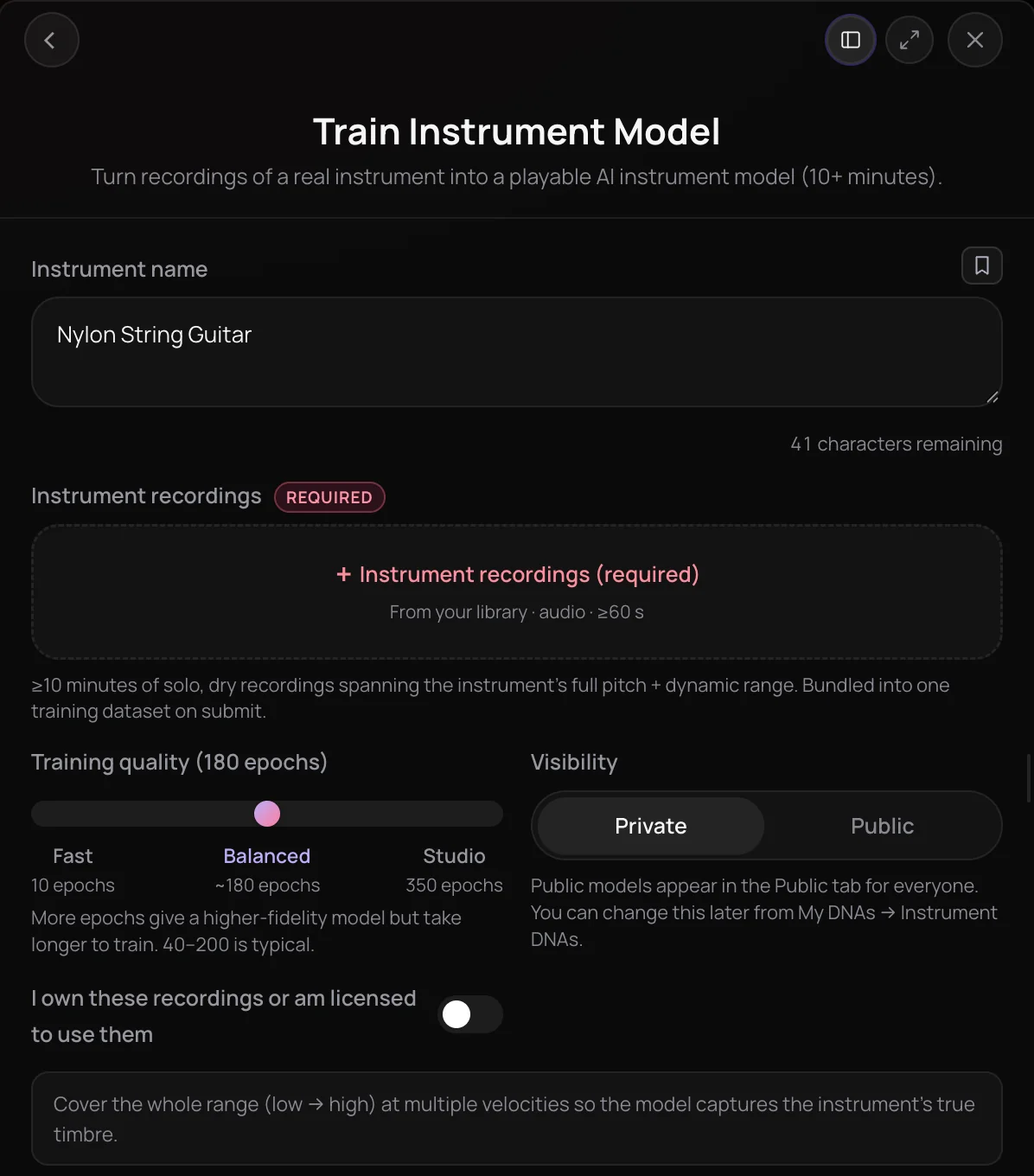
Train Instrument Model builds an AI instrument model from at least 10 minutes of recordings of an instrument you play. It is for players and producers who want their own instrument's sound, such as a cello or a sitar, playable with their voice. When training finishes, hum or sing a line in Voice to Instrument and hear it come back as your instrument.
See it in action
- Train an AI Model of Your Own Instrument, Then Hum to Play It | Soundverse Recordings of an instrument you play become your own instrument model, which you then play by humming in Voice to Instrument.
How it works
Name your instrument
Open Train Instrument Model under Build & Train in AI Tools and type an Instrument name, such as My Nylon Guitar.
Add your recordings
Pick at least 10 minutes of solo, dry recordings from your Library, each at least 60 seconds, covering low to high notes played both soft and loud.
Set quality and visibility
Slide Training quality from 10 epochs (Fast) to 350 (Studio); 180 is the default. Keep the model Private or make it Public, then turn on the consent switch.
Train, then play it
Press Start Training and follow each epoch in the chat. When it finishes, your model is under My DNA and in Voice to Instrument, under Yours.
Why use Train Instrument Model
Your instrument, your sound
The model learns from recordings of the instrument you play, so it captures that instrument's timbre instead of one of the built-in presets.
Play it with your voice
In Voice to Instrument, hum or sing a melody and hear it come back in the sound of the instrument you trained.
Choose your training depth
Slide from 10 to 350 epochs. More epochs give a higher-fidelity model but take longer to train and use more tokens.
Watch it train
The chat shows the upload and each epoch, and Voice to Instrument lists the run as Training until it is ready to pick.
What it costs
Needs Creator or above.
- Train at 180 epochs (the default): 5,700 tokens at 30 tokens an epoch (about $14.24–$17.80 on Creator, with a top-up, or ₹569–₹711 in India).
Training costs 300 tokens plus 30 an epoch: 600 at 10 epochs, 10,800 at 350.
A run costs more than Creator's 4,000 monthly tokens, so on Creator it needs a top-up. Pro includes 10,000 a month.
Creator $12.49 a month, or $9.99 a month billed yearly ($119.88 a year) · Pro $31.24 a month, or $24.99 a month billed yearly ($299.88 a year) · Max from $72 a month, or $60 a month billed yearly ($720 a year).
In India (PayU): Creator ₹499 a month, or ₹399 a month billed yearly (₹4,788 a year) · Pro ₹1,299 a month, or ₹1,039 a month billed yearly (₹12,468 a year) · Max from ₹2,999 a month, or ₹2,399 a month billed yearly (₹28,788 a year).
Prices outside India are in US dollars, billed through Stripe; in India they are in rupees, billed through PayU. Monthly tokens reset each month and don't roll over.
Frequently asked questions
Is Train Instrument Model free?
Train Instrument Model is available on the Creator plan and above, and each training run uses tokens from your plan. The cost depends on the epochs you choose, and the panel shows it before you start. Soundverse is free to sign up, and paid plans add a commercial license for what you make; the Pricing page lists what each plan covers.
How many tokens does Train Instrument Model use?
Train Instrument Model costs 300 tokens plus 30 for each epoch: 600 at 10 epochs, 5,700 at the default 180, and 10,800 at 350. The default is more than the 4,000 tokens the Creator plan adds each month, so on Creator, train with fewer epochs or add a top-up, or choose Pro, which adds 10,000 a month. Playing your model in Voice to Instrument then costs 150 tokens a run.
What are the limits of an instrument model?
Train Instrument Model learns only from the recordings you give it, so cover the instrument's full range at different strengths; background music, noise or other instruments in the takes lower quality. It doesn't compose or arrange by itself: it gives Voice to Instrument a new sound for your melodies. Built-in presets such as sitar, bansuri and flute need no training at all.
Can I train a model on recordings I didn't make?
Only if you are licensed to use them. Train Instrument Model asks you to confirm “I own these recordings or am licensed to use them”, and Start Training stays disabled until you switch it on. Recordings of your own playing are the simplest and safest source. You need the rights to anything you upload.
How long does it take to train an instrument model?
Train Instrument Model runs the same background training as Train Voice Model, so a model is ready hours after you press Start Training, not minutes. Higher Training quality settings take longer, from 10 epochs at the Fast end to 350 at Studio. The chat shows each epoch, and Voice to Instrument lists the run as Training until it is ready.
What is Train Instrument Model?
Train Instrument Model is the Soundverse tool that turns at least 10 minutes of recordings of an instrument you play into an AI instrument model. Soundverse adds the finished model to Voice to Instrument, where you hum or sing a melody and hear it played back in your instrument's sound.
What recordings do I need to train an instrument model?
Train Instrument Model needs at least 10 minutes of solo, dry, close-miked recordings of one instrument, with each clip at least 60 seconds long. Cover the whole range from low to high notes at different strengths, and include sustained notes and articulations so the model captures the instrument's true timbre. Train Instrument Model takes MP3, WAV, FLAC and M4A files from your Library.
How do I play my instrument model after training?
Open Voice to Instrument, add a hummed or sung melody, and choose your trained model under the Yours tab. Voice to Instrument maps the pitch and rhythm of your line onto the instrument you trained, so a hummed phrase comes back as your cello or guitar. Models you trained with Train Instrument Model also appear under My DNA.
How is an instrument model different from a voice model?
Train Instrument Model and Train Voice Model run the same training with the same epoch range and visibility settings; the main difference is the target. An instrument model learns from solo recordings of an instrument and plays your hummed melodies in Voice to Instrument, while a voice model learns from a voice and re-sings vocals in Voice Swap.
Ready to train your instrument?
Add at least 10 minutes of solo recordings, pick the training quality and start training.